Inter-VLAN Routing Tutorial
The previous tutorial covered how VLANs segment a network into separate logical broadcast domains. This one picks up from there and looks at InterVLAN routing — how devices in different VLANs actually reach each other.
What is InterVLAN routing?
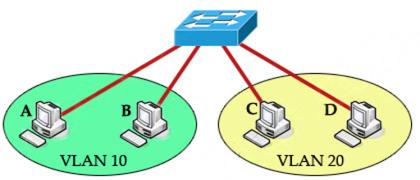
As covered previously, devices within the same VLAN can reach each other without any Layer 3 routing involved. Devices in different VLANs, though, need a Layer 3 device in the path to communicate. In the topology below, host A and host B — both in VLAN 10 — can talk to each other with no router required; host C and host D, both in VLAN 20, can do the same. But host A can’t reach host C or host D at all, since they sit in a different VLAN.
The rest of this article is for members
The full walkthrough, configuration examples and verification steps are available exclusively to paid members.
View membership plans Log in